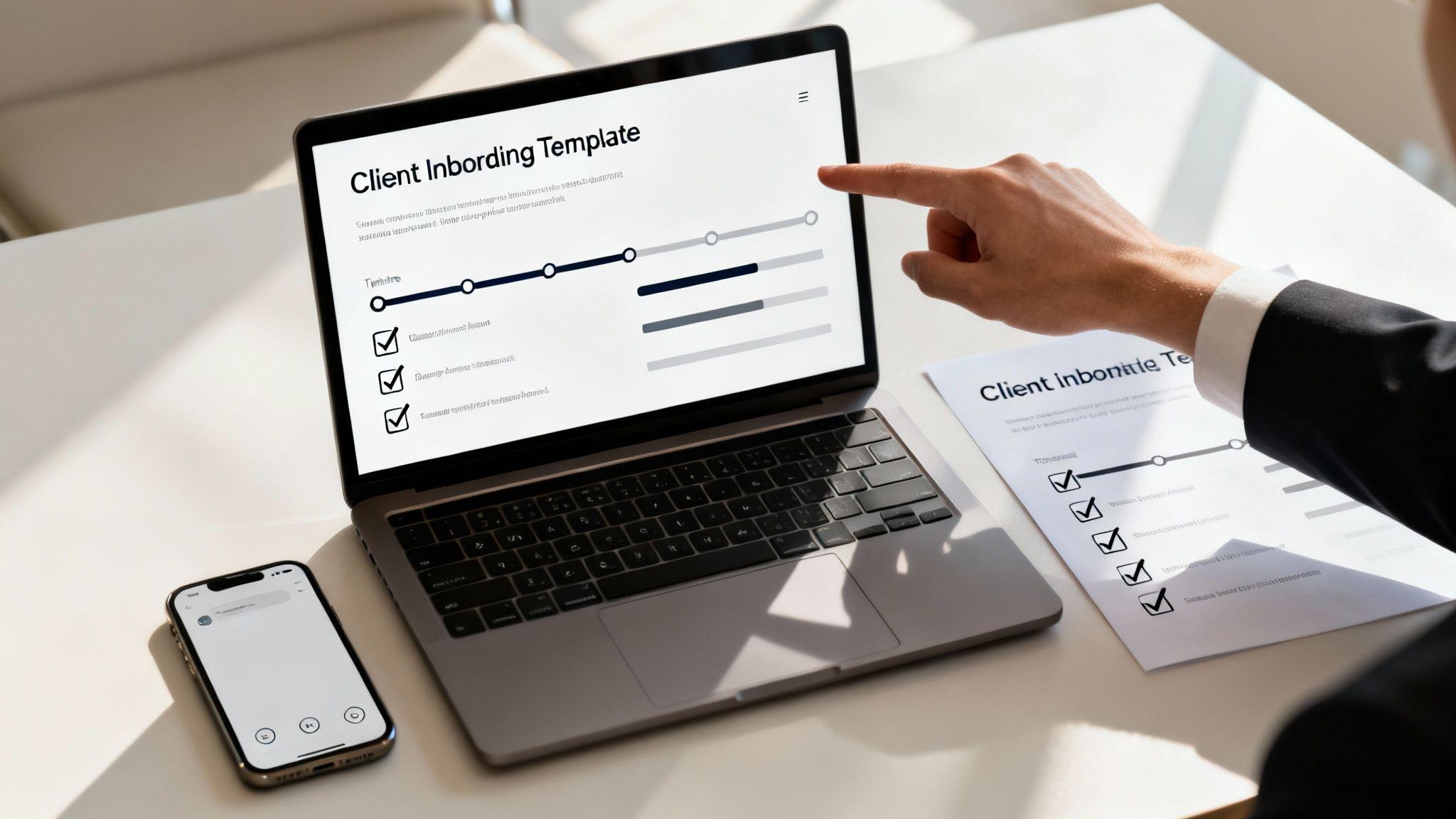
A solid client onboarding process template is more than a simple checklist; it's a strategic plan to keep clients happy and boost your revenue, starting from day one. When you standardize how you welcome new clients, you create a predictable, professional, and positive first impression every single time.
Why a Repeatable Onboarding Process Matters
You never get a second chance to make a first impression. A rocky start, full of missed deadlines or confusing communication, can damage a new client relationship permanently. This is where a repeatable, structured onboarding process becomes your most valuable asset. It shifts your client interactions from being reactive and chaotic to proactive and controlled.
It’s the difference between handing a client a box of furniture parts with no instructions and giving them a clear, step-by-step guide. A defined process ensures nothing gets missed, setting a professional tone that builds trust immediately.
Actionable Tip: Create a simple checklist for your first five client interactions. This could include sending the contract, the welcome email, scheduling the kickoff call, sending the intake form, and a follow-up reminder. This small step ensures consistency.
The Financial Impact of a Strong Start
A smooth start has a direct link to long-term client loyalty and your bottom line. When clients feel supported and see you delivering value quickly, they are far less likely to leave. That initial period is make-or-break; it’s when most customers decide if they’re sticking around.
The numbers don't lie. Companies that get serious about their onboarding process see major financial upsides. A well-designed onboarding template can boost customer retention by 15–25% and cut early-stage churn by as much as 25%.
And when you consider that getting a new customer costs 5 to 25 times more than keeping a current one, even a small improvement in retention delivers a huge return. If you explore more data on how onboarding impacts business growth, you'll see just how critical it is.
Beyond Checklists to Client Advocacy
Ultimately, an onboarding template isn't just an administrative tool—it's how you begin building a real relationship. It's your first and best opportunity to prove your value and turn a brand-new customer into a vocal advocate for your business.
A great onboarding process does more than just welcome a client. It systematically removes friction, manages expectations, and demonstrates your expertise, turning a transaction into a long-term partnership.
By standardizing those crucial first steps, you create a foundation of trust that supports the entire client lifecycle. This consistency prevents common frustrations, reinforces the client's decision to hire you, and paves the way for future success and referrals.
The Anatomy of a Powerful Onboarding Experience
A stellar client relationship doesn’t just happen—it’s built, step by step, from the moment a client says “yes.” An effective client onboarding process template is a carefully crafted journey that builds momentum and trust right from the start.
Breaking the process into distinct phases creates a clear, manageable path for both you and your new client. It turns a potential flood of information into a series of achievable milestones, ensuring nothing critical falls through the cracks. This structured journey is what separates a good first impression from a lasting partnership.

As you can see, every step in a well-planned process builds on the last. You’re not just completing tasks; you’re turning initial excitement into genuine, lasting loyalty.
Kicking Things Off: Welcome And Discovery
The first few days are about setting the stage and understanding the client's needs. Your goal is to make your new client feel confident in their decision while clarifying what comes next. This is your chance to align expectations and gather all the details you need for a successful project.
The most valuable tool in this phase is a solid client intake form. It’s a strategic way to understand their goals, challenges, and what success looks like to them. To nail this, check out our guide on building an effective client intake form template that gets you the answers you need.
Actionable Tips for this phase:
- Send a welcome packet: Include the signed contract, a high-level project timeline, and introductions to key team members.
- Schedule the kickoff call: Get the first strategic meeting on the calendar to discuss goals and scope in detail.
- Assign light "homework": Ask the client to complete the intake form or grant access to essential accounts like Google Analytics or social media profiles.
Getting The Keys: Setup And Implementation
With the foundational information gathered, it’s time for the technical setup. This phase involves configuring all the systems, tools, and access permissions so the real work can begin smoothly. A seamless execution here demonstrates your organization and competence.
For example, a marketing agency would request access to a client’s Google Analytics and ad accounts. A software company would set up user accounts and configure the platform for the new client.
The Setup and Implementation phase is where promises turn into tangible progress. A seamless technical setup is one of the first ways a client experiences your competence firsthand.
Building Confidence: Training And Activation
Now that the system is ready, you need to empower your client to use it effectively. This phase is about education, ensuring they know how to work with your team or use your product confidently.
This doesn't have to be a single, long training session. It’s often more effective as a series of smaller actions:
- A live, personalized demo of your software.
- Access to a library of short tutorial videos or a knowledge base.
- A quick walkthrough of your project management tool to explain how you'll communicate updates.
Looking Back, Moving Forward: Review And Transition
The final onboarding phase marks the shift from setting up to working together. Here, you review the progress made, confirm the client is satisfied, and formally transition them to their long-term account manager or support contact.
Actionable Tip: Schedule a mandatory 30-day or 90-day check-in. Use this meeting to address any questions, highlight early wins, and reinforce the value you’ve delivered. This formal touchpoint solidifies the relationship and ensures a smooth transition to a long-term partnership.
How to Personalize Your Onboarding Experience
A good template provides a reliable process, but personalization is what builds the relationship. A generic approach can make a client feel like just another number. The magic happens when you make each client feel seen and understood, without creating extra work for your team. This involves making small, thoughtful adjustments that show you’ve been listening.
Use Intake Data to Create a Custom Welcome
Your client intake form is a goldmine of information. Instead of just filing it away, use key details to customize your welcome message and kickoff call agenda. This simple action immediately shows you value their input.
For example, if a client mentions their biggest challenge is "generating more qualified leads," you can adjust your welcome email:
- Generic: "We're excited to start working on your marketing."
- Personalized: "We're so excited to dive in and start building a strategy to generate more qualified leads for your business."
This small change proves you heard their main concern and are already focused on it.
Actionable Tip: Create a short, industry-specific resource guide. If you sign a new restaurant, send them a one-page PDF on "5 Social Media Post Ideas for Restaurants This Month." It’s a low-effort, high-impact way to deliver immediate value.
Personalization isn't about grand gestures; it's about proving you've paid attention to the details. It’s the difference between a client feeling processed and feeling prioritized.
Build Different Paths for Different Clients
Your onboarding template can be more than a static checklist. Think of it as an adaptable guide that changes based on the client. By building in simple variations, you can create different onboarding paths for different client types, ensuring they only receive relevant information.
Here’s how to set this up:
- Role-Based Training: For larger companies, the marketing manager and sales director may need different training. Create separate, concise training modules for each role.
- Service-Level Checklists: A client on a basic plan might get a simple 5-step checklist, while a premium client receives a more detailed 10-step version with extra check-ins.
These adjustments pay off. Research shows that 58% of customers felt a customized onboarding experience boosted their trust and engagement.
Furthermore, B2B companies found that positive onboarding drove repeat business in 62% of cases. The data is clear: tailoring the journey leads to happier clients who stick around longer. You can dig into more insights on how onboarding statistics drive business results to see just how big of an impact this can have.
Streamlining Your Workflow with Smart Automation
Running your client onboarding process manually is inefficient and prone to errors. Relying on manual tasks leads to inconsistencies, mistakes, and a burnt-out team. This is where automation becomes your secret weapon.
By automating repetitive tasks, you guarantee every client gets the same high-quality, consistent experience. This isn't about removing the human touch; it's about freeing up your team to focus on building relationships instead of administrative work.

Setting Up Your First Automations
Getting started with automation is easier than you think. It boils down to "triggers" and "actions." A trigger is an event that happens (e.g., a contract is signed), and an action is what you want to happen next (e.g., send a welcome email).
For example, when a client signs your contract (the trigger), an automated action can instantly send a pre-written welcome email with the next steps.
Actionable Automation Ideas:
- Trigger: Client signs the contract.
- Action: Automatically send a welcome email with a link to their client portal and intake form.
- Trigger: Client submits their intake form.
- Action: Create a task in your project management tool for your project manager to review the form and schedule the kickoff call.
- Trigger: Kickoff call is booked on the calendar.
- Action: Send an automated reminder email 24 hours before the meeting with the agenda and video conference link.
Automation is all about creating momentum. It ensures that the second one milestone is hit, the next step is already in motion. This prevents those awkward silences and delays that can absolutely kill a new client's excitement.
The Power of Automated Scheduling and Reminders
The back-and-forth emails to schedule meetings can be a huge time drain. Integrating a smart booking system is a game-changer for your client onboarding process template. When a client can click a link, see your availability, and book a kickoff call directly, you eliminate a frustrating process. We have a great starting point in our guide on setting up a booking system for small business.
Automated reminders for pending invoices or incomplete forms are just as valuable. These gentle nudges keep the process moving without you having to act as a bill collector.
Despite the clear benefits, there's a huge gap in adoption. While 93% of organizations see automation as vital for successful onboarding, only about a quarter have actually automated their processes. Automating tasks like document signing and milestone emails can reduce administrative time by 30–60% and cut early-stage support questions by up to 40%.
Build a Central Onboarding Hub for Your Clients
Scattered emails and lost attachments create confusion and make you look disorganized. A central onboarding hub—a single, dedicated online space—replaces chaos with clarity. It shows you're a professional who is in control. This doesn't require a complex, custom-coded portal; it’s about creating one source of truth for your new client.
With a tool like the Solo AI Website Creator, you can quickly build a simple, password-protected page for this purpose. Think of it as your client’s private project command center, a place they can go anytime to find what they need.
Designing Your Client Hub Page
Putting this hub together is straightforward. The goal is to present all essential onboarding information in one clean, easy-to-find location. You’re essentially creating a private webpage for their onboarding journey.
Using the Solo AI Website Creator, you can quickly create a new page and password-protect it to keep project details confidential. Then, you can add key elements from your client onboarding process template.
Here’s a look at the kind of intuitive dashboard you'd use in the Solo AI Website Creator to manage your site pages.

The clean layout makes it easy to add new pages, forms, and booking features, even if you have zero technical skills.
What to Include in Your Onboarding Hub
Your client hub should be a one-stop shop that anticipates their questions, saving you time and making your client feel supported.
Actionable Checklist for Your Hub:
- A Personal Welcome: A short video or a warm written message from their main point of contact.
- Embedded Intake Form: Allow them to fill out questionnaires directly on the page.
- Project Timeline: An embedded calendar or a simple visual graphic showing key milestones.
- Key Resources: Links to important documents, style guides, or reference materials.
- Contact Information: Clear details on who to contact for what, including your business hours.
- Scheduling Link: An embedded booking calendar for scheduling the kickoff call.
A centralized onboarding hub transforms your process from a series of disjointed emails into a structured, premium client experience. It immediately demonstrates your value and organizational skills.
Integrating a booking system is particularly powerful. With the Solo AI Website Creator, you can add a scheduling block directly to the hub page. This lets clients book their kickoff call in a few clicks, eliminating the painful back-and-forth of finding a time. If you want to go deeper, check out our guide on finding a great website builder with a booking system. By consolidating these steps, you create a seamless flow that guides your client confidently into the project.
Of course, here is the rewritten section following your specific guidelines:
Answering Your Top Onboarding Questions
Even with a rock-solid onboarding process, you're going to get questions. That's a good thing! It means your clients are engaged. Knowing how to handle these common queries with confidence is what keeps the whole process running like a well-oiled machine. Let’s tackle some of the questions I hear the most.
How Long Should Client Onboarding Take?
There's no magic number here—it all boils down to how complex your service is. Onboarding a client for a straightforward freelance project might only take a week. On the other hand, implementing a complex piece of software could easily be a 90-day journey.
The most important thing isn't the total time but the clarity you provide. Your process should lay out clear milestones so clients know exactly what success looks like at each stage.
Actionable Timeline Template:
- First 7 Days: Focus on the welcome, the initial discovery call, and gathering all necessary access and logins.
- First 30 Days: The goal is to deliver the first tangible "win." This could be a completed deliverable or finishing the initial setup. Give them a taste of success early.
- First 90 Days: By this point, your client should be fully integrated and starting to see real, measurable value from your work.
Communicating this timeline right from the start is crucial. It manages expectations and stops clients from nervously wondering if things are on track.
What Are the Biggest Onboarding Mistakes to Avoid?
Honestly, the most common stumbles are surprisingly simple: bad communication, fuzzy expectations, and just plain information overload. Drowning a new client in documents, forms, and requests on day one is a surefire way to kill all their excitement.
The goal is to guide, not overwhelm. A great onboarding experience delivers the right information at exactly the right time, building momentum instead of creating friction.
Another huge mistake I see people make is not automating the simple, repetitive stuff. Manually sending every single reminder email or follow-up is a massive time sink. More than that, it opens the door for human error, which leads straight to an inconsistent and unprofessional client experience.
How Can I Measure Onboarding Success?
You can't improve what you don't measure. To know if your process is actually working, you need to be tracking a few key metrics. This data will tell you exactly what’s clicking and where you might need to make some tweaks.
Actionable Metrics to Track:
- Time-to-Value (TTV): How fast does a new client get their first meaningful result? The shorter this is, the better.
- Client Satisfaction Scores: Use simple CSAT or NPS surveys after 30 or 90 days. It’s the most direct way to get honest feedback.
- Onboarding Completion Rates: Are clients actually finishing all the steps? A big drop-off at a certain point is a red flag that something is confusing or causing friction.
- New Client Support Tickets: A great onboarding process should answer most common questions before they're even asked. A low number of support requests early on is a fantastic sign.
Keeping an eye on these numbers will give you real, actionable insights to constantly refine and improve your client onboarding experience.
Ready to build a professional, centralized hub for your clients in minutes? The Solo AI Website Creator makes it easy to create secure client pages, embed forms, and add booking flows without any technical skills. Create your free website with Soloist.ai today!
Why is a repeatable client onboarding process so important?
A repeatable process turns onboarding from reactive and chaotic into proactive and controlled. It helps prevent missed steps, sets a professional tone, builds trust early, and supports better retention because clients feel supported and see value quickly.
What phases should a strong client onboarding process template include?
A strong template should cover welcome and discovery, setup and implementation, training and activation, and review and transition. Breaking onboarding into these phases creates clear milestones, keeps information manageable, and reduces the chance that important tasks fall through the cracks.
How can you personalize onboarding without creating extra work?
Use intake form details to tailor the welcome message, kickoff agenda, and early resources around the client’s stated goals and challenges. You can also build simple variations such as role-based training or different checklists by service level so clients only receive information that is relevant to them.
What parts of onboarding are best suited for automation?
Automation works best for repetitive steps such as sending welcome emails after contract signing, creating internal review tasks after intake form submission, and sending reminders before kickoff calls. These trigger-based actions keep momentum going, reduce administrative work, and make the experience more consistent.
What should a client onboarding checklist include in the first few interactions?
The first checklist should cover sending the contract, delivering a welcome email, scheduling the kickoff call, sending the intake form, and following up with a reminder. These early actions create structure, clarify next steps, and help both sides start the relationship with confidence.
What is a central onboarding hub and why does it help customer experience?
A central onboarding hub is a single online space where clients can find key onboarding information, documents, timelines, and updates. It reduces confusion from scattered emails and attachments, gives clients one source of truth, and reinforces a sense of organization and professionalism.