
How to market your business online: The ultimate growth playbook
This article was assisted with AI. We may include links to partners.
Before you pour a single dollar into ads or spend an hour crafting the perfect social media post, you need to lay the groundwork. The absolute cornerstone of any effective online marketing is a professional website—your digital headquarters.
This isn't just an online business card; it's a tireless, 24/7 sales and lead generation machine that works for you even when you’re off the clock. Every other marketing effort you make will ultimately point back to this one central hub.
Build Your Digital Foundation First
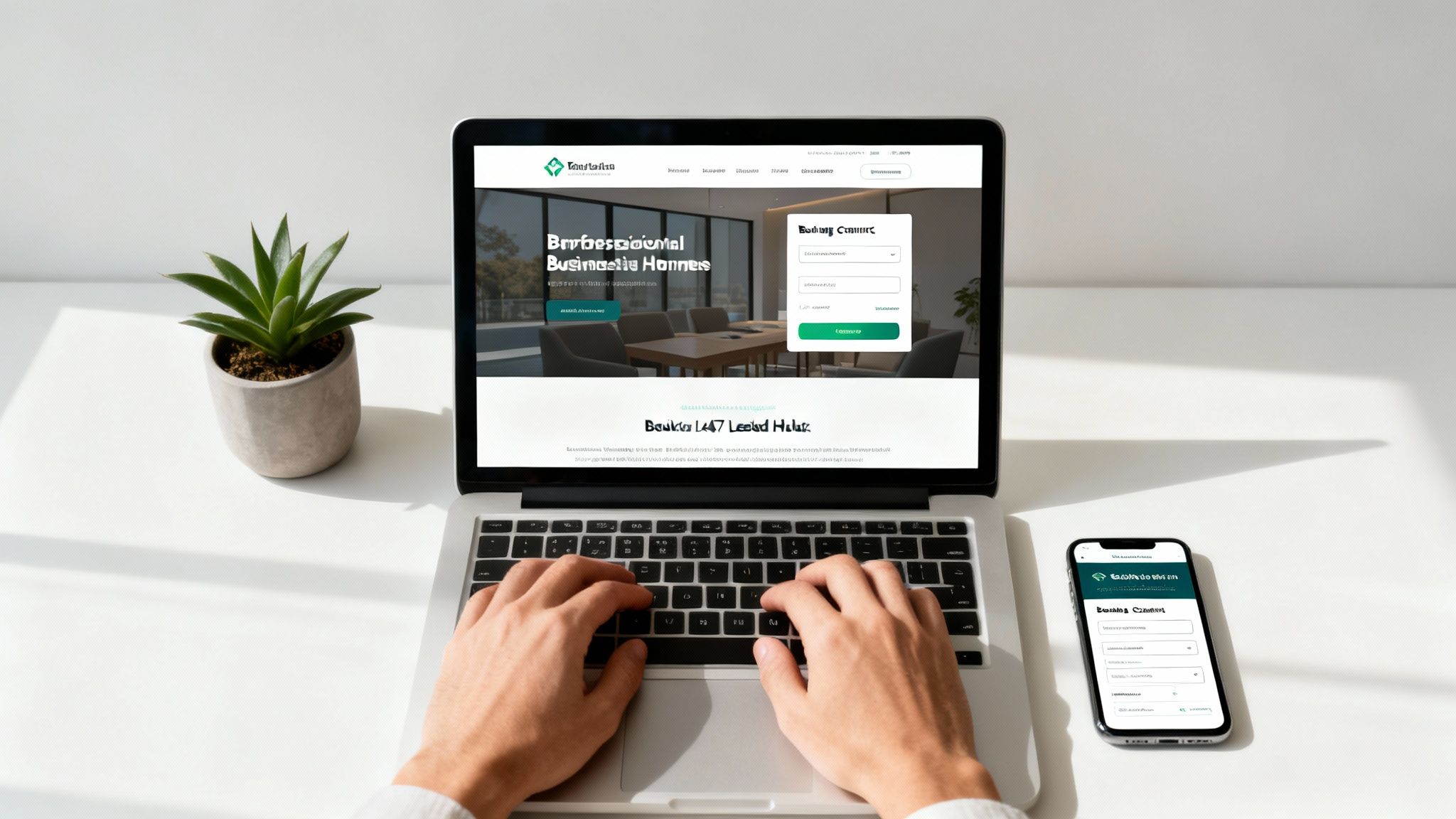
Think of your website as your digital storefront. It’s the final destination for people who find you through a Google search, click on your email newsletter, or see your ad. Without a solid, professional site, you’re essentially building your business on rented land—like social media platforms where you have zero control over the rules.
The great news? You don't need to be a tech wizard or have a massive budget to get this done anymore. Tools like the Solo AI Website Creator let you launch a site that not only looks incredible but is also engineered to actually grow your business, all without writing a single line of code.
From Brochure to Business Engine
A truly effective website does more than just list your services. It needs to be a dynamic tool that actively turns curious visitors into paying customers. It should be capturing leads, automating your booking process, and answering questions so you don't have to.
So, what transforms a basic site into a real business engine? It comes down to a few key features:
- Integrated Booking Systems: Let clients schedule appointments right on your site. This simple feature cuts down on endless back-and-forth emails and captures business the moment a client is ready to commit.
- Client Contact Forms: Give potential customers a dead-simple way to get in touch. Every submission adds a new lead directly into your pipeline.
- Industry-Specific Design: Your website should look and feel like it belongs in your field. A real estate agent needs stunning property galleries, while a local clinic needs easy-to-find patient forms.
With these elements in place, your website stops being a passive brochure and becomes an active partner in your growth. It’s the core of your strategy to build an online presence, working behind the scenes to hit your business goals.
Why Your Website Is Non-Negotiable
Relying only on social media is a gamble. One algorithm change can decimate your reach overnight, and you never truly own your list of followers. Your website, however, is an asset you have complete control over. It's your permanent address on the internet, where you make the rules.
Your website is the only marketing channel you truly own. Every other platform is borrowed land where the rules can change without notice. Investing in your own site ensures you have a stable foundation for long-term growth.
A powerful website isn't just a "nice-to-have"—it's a must-have. Here's a look at the essential features your site needs to support your marketing and drive real results.
Essential Website Features for Effective Marketing
| Feature | Why It's Critical for Marketing | How Solo AI Website Creator Helps |
|---|---|---|
| Mobile-First Design | Over 60% of web traffic is mobile. If your site isn't flawless on a phone, you're losing customers. | Every site is automatically responsive, ensuring a perfect experience on any device. |
| Integrated Booking | It converts intent into action instantly, capturing revenue while the visitor is engaged. | Seamlessly integrates booking calendars directly into your site, no plugins needed. |
| Lead Capture Forms | Your website is your primary tool for building an email list and a pipeline of potential clients. | Simple, drag-and-drop forms make it easy to collect information from interested visitors. |
| Fast Loading Speed | Slow sites frustrate users and hurt your Google rankings. Every second counts. | Optimized for performance out of the box, so your pages load quickly. |
| SEO-Friendly Structure | A solid technical foundation helps search engines find, crawl, and rank your content. | Built with SEO best practices in mind, from clean code to customizable meta tags. |
Having these features built into your website from day one gives your marketing campaigns a place to land and convert, maximizing the return on every dollar you spend.
The proof is in the numbers. Global digital ad spend soared to $601.8 billion in 2023 and is projected to hit $730 billion by 2025. Businesses are moving their money online because that's where the customers are, with 67% of all media spending now happening in digital channels.
Of course, a website is just the first step. For a wider view of your options, check out this practical guide to advertising for small businesses. By getting your website right first, you guarantee that when people click your ads, they arrive at a professional, effective platform that’s ready to turn their interest into action.
Master SEO to Attract Ready-to-Buy Customers

Alright, your professional website is live. Now, we need to make sure people can actually find it. This is where Search Engine Optimization (SEO) comes in.
In simple terms, SEO is the process of making your website more attractive to search engines like Google. It isn't about tricking the system. It’s about making your website genuinely helpful for both search engines and, more importantly, for people.
When you get it right, your business shows up when potential customers are actively searching for what you do. This can bring a steady stream of high-quality visitors right to your digital doorstep, often for free.
Understand What Your Customers Are Searching For
The foundation of good SEO is understanding the words and phrases your customers type into Google. These are called keywords. Your job is to figure out the exact phrases your ideal customer uses when they need your help.
Let’s say you’re a home painter in Denver. Your potential customers probably aren't just searching for "painter." They’re getting way more specific.
They might be looking for things like:
- "best exterior house painters in Denver"
- "cost to paint kitchen cabinets Denver"
- "local painting company for historic homes"
Each of these more specific, longer phrases reveals a very clear need. When you identify these, you can create pages and content on your site that directly answer those questions. This attracts visitors who are much closer to making a buying decision.
Optimize Your Website Pages for Clicks
Once you have your keywords, you need to signal to Google that your pages are a great match. This is called on-page SEO, and it's less complicated than it sounds. It simply means placing your target keywords in a few important spots on your website so search engines know what each page is about.
The goal of on-page SEO isn't just to rank higher—it's to convince a searcher that your page is the best possible answer to their query. Your title and description are your first impression, so make them compelling.
When you're using a tool like the Solo AI Website Creator, you have direct control over these elements for every single page. You’ll want to focus on two main spots:
- Page Titles (or Title Tags): This is the blue, clickable headline you see in Google search results. It needs to include your main keyword and a clear benefit. Instead of a boring title like "Services," try something like "Professional Interior Painting in Denver | Free Estimates."
- Meta Descriptions: This is the short summary of text under the title in search results. While it doesn't directly boost your rank, a good description persuades people to click your link instead of a competitor's. Mention what makes you special, like "20+ Years of Experience" or "Eco-Friendly Paint Options."
Just making these small tweaks can seriously boost how many people click on your site, sending more qualified traffic your way without spending a dime on ads. For a deeper look into these techniques, our small business SEO guide has even more actionable steps.
Dominate Your Local Market
If your business serves a specific city or region, local SEO will be your most powerful marketing tool. It’s all about showing up in relevant local searches.
Actionable Tip: The most important first step is to create and polish your Google Business Profile (GBP). This free listing is what allows your business to appear in Google Maps and the "Local Pack" that often shows up at the top of search results. To really pull in customers who are ready to buy now, you have to master the fundamental SEO basics for home service websites.
Make sure you completely fill out your GBP profile with your business name, address, phone number, hours, and plenty of photos. Then, gently encourage your happy customers to leave reviews. Those positive ratings build trust and give your local ranking a major boost.
Create Content That Connects and Converts
Alright, you've got a professional website and your SEO strategy is starting to work. Now it's time to fuel that engine with high-quality content. This is the bridge that connects what you know with what your audience needs to know.
Content is how you build trust and prove you're an expert. It’s how you guide someone from being a curious visitor to a loyal customer. This isn’t about just churning out blog posts. It’s about creating genuinely helpful resources that answer your customers' most pressing questions.
Brainstorming Content Your Customers Actually Want
The best content ideas come directly from your customers' pain points. Instead of guessing what they want to read, just listen to the problems they bring to you every day.
Actionable Tip: List the top 10 questions you get from new clients. That's your content goldmine.
For instance, a freelance graphic designer probably hears these all the time:
- "How much does a professional logo really cost?"
- "What's the difference between a brand guide and just a logo?"
- "Do I actually need a whole new website design?"
Every one of those questions is a perfect launchpad for a blog post, a short video, or a social media post. By answering them publicly, you're not just helping one person—you're building trust with a wider audience wondering the exact same things.
Your best content will always be a direct answer to a customer's question. Stop selling and start helping; the sales will naturally follow.
Planning for Consistency with a Content Calendar
Want to stay top-of-mind? The secret is consistency. Random posts won’t build momentum. A simple content calendar is all you need to stay on track.
Actionable Tip: Map out your content one month ahead. Plan for one bigger piece each week—maybe an in-depth blog post. Then, schedule smaller social media posts that you can pull directly from that main piece. This makes your marketing feel manageable and sustainable.
Going Beyond the Standard Blog Post
While blog posts are fantastic for SEO, people consume information in different ways. To connect with a wider audience, mix up your content formats.
Here are a few powerful options:
- Client Case Studies: Nothing builds trust faster than showing real-world results. A simple story outlining a client's problem, your solution, and the amazing outcome is one of the most persuasive marketing assets you can create.
- Short-Form Video Testimonials: Just ask a happy client to record a quick 30-second video on their phone. These raw, unpolished clips are incredibly powerful on social media and your website.
- In-Depth Industry Guides: Put together a comprehensive guide that covers a major topic in your field from A to Z. This immediately positions you as an authority and becomes a valuable resource.
This varied approach keeps your audience engaged and shows off your expertise from multiple angles. It also makes sure the website copy you write is backed by rich, helpful content that proves you can deliver. For more on this, check out our detailed article on how to write website copy that truly sells.
The Power of Repurposing Content
You do not need to create something new from scratch every single day. The smartest marketers work smarter, not harder. The key is to take one great piece of content and adapt it for multiple platforms.
Here’s what that looks like in practice:
- Start with a Pillar Post: Write a detailed article like "5 Common Mistakes Businesses Make with Their First Website."
- Create a Social Media Carousel: Turn each of the 5 mistakes into a separate, eye-catching slide for an Instagram or LinkedIn carousel.
- Film a Short Video: Record a 60-second video diving into the #1 biggest mistake from your list. Perfect for TikTok or Instagram Reels.
- Craft a Newsletter: Send an email to your subscribers that highlights the three most important takeaways from the original article, with a link back to the full post.
From one core idea, you’ve just created a week's worth of marketing material. This strategy maximizes the impact of your efforts and saves you a ton of time.
Engage Your Audience with Social Media and Email
Okay, you’ve got a fantastic website and a solid content plan. Now it's time to actually talk to your audience. This is where social media and email marketing come in. Think of them as your direct lines for building a community and encouraging repeat business.
The biggest mistake is trying to be everywhere at once. Spreading yourself thin is a surefire way to get burned out. The goal is to find the one or two platforms where your ideal customers are already hanging out, and then show up there consistently.
Find Your Social Media Sweet Spot
Don't just jump on every new platform. A local plumber is going to find way more valuable leads on a community-focused platform like Facebook than on TikTok. On the other hand, a freelance photographer could build a massive following on a visual-first platform like Instagram.
To find your focus, ask yourself a few simple questions:
- Where are my customers? If you sell to other businesses, LinkedIn is probably a no-brainer. Selling to a younger crowd? Instagram might be your jam.
- What am I good at creating? If you're comfortable on camera, short-form video is a great option. If you’re a better writer, focus on platforms that value that.
- What’s the vibe? Every platform has its own personality. Pick the one that feels the most natural for your brand.
Once you’ve picked your channels, treat your profile like a mini-homepage. Your bio needs to instantly tell people who you are, who you help, and what you do.
This decision tree is a great way to visualize how your main marketing goal should shape the kind of content you create.
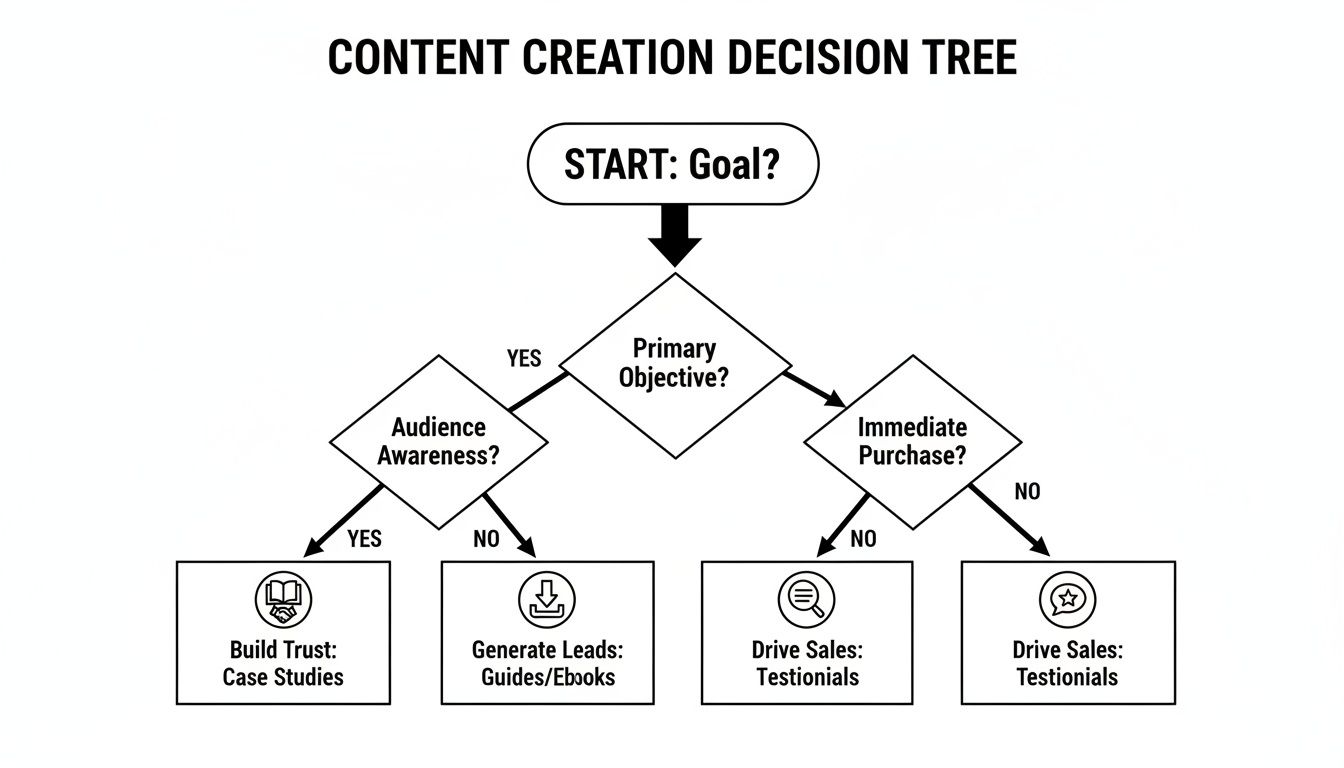
As you can see, the content you make should be a direct answer to your business goal—whether that's building trust with case studies or driving sales with testimonials.
Choosing where to invest your precious time can be tough. Here’s a quick breakdown of the most popular channels to help you decide.
Choosing Your Best Marketing Channels
| Marketing Channel | Best For | Effort Level | Cost Level |
|---|---|---|---|
| Email Marketing | Nurturing leads, customer retention, direct sales promotions | Low to Medium | Low |
| SEO & Blogging | Building long-term authority, generating organic traffic, educating customers | Medium to High | Low to Medium |
| Building community, local business targeting, broad audience reach | Medium | Low to High | |
| Visual brands (e.g., artists, retail, food), influencer marketing | Medium | Low to High | |
| B2B networking, professional services, thought leadership | Medium | Low to High | |
| Paid Ads (Google/Social) | Immediate traffic, specific targeting, lead generation | High | Medium to High |
Ultimately, the best channels are the ones you can commit to consistently. It’s better to do an amazing job on one platform than a mediocre job on five.
Turn Website Visitors into Loyal Subscribers
Social media is great for getting in front of new people, but you don't own your followers. Building an email list is one of the most important things you can do. It's a direct, reliable communication channel that you completely control.
Your Solo AI Website Creator site is already set up to help you do this. Those built-in client contact forms are your golden ticket for collecting email addresses from people who are already interested in what you do.
An email list is more than just a bunch of contacts; it's a genuine business asset. These are people who have literally raised their hand and said, "Yes, I want to hear from you." Treat that permission with respect by always providing value.
Once you start getting sign-ups, you don't need a complex strategy. Just start with a simple, automated welcome email that goes out right after someone subscribes.
Actionable Tip: Your first email can be super simple:
- Say thanks and confirm they're on the list.
- Briefly re-introduce yourself and what you do.
- Set expectations. Let them know if you'll be emailing monthly, weekly, etc.
- Offer something valuable, like a link to your best blog post or a small discount.
From there, a simple monthly newsletter is the perfect way to stay top-of-mind. Share a recent project, a helpful tip, or a special offer. The goal is to nurture that relationship by being helpful, not just by selling all the time.
Flip the Switch with Paid Advertising
Let’s be real: organic strategies like SEO and content marketing are the bedrock of long-term growth. But they take time.
Paid advertising, on the other hand, is like flipping a switch. It delivers immediate visibility, putting you directly in front of your ideal customers the moment you launch a campaign. It’s how you jumpstart growth or just get the phone ringing right now. A smart marketing plan uses both organic and paid strategies.
Search Ads: Capture People Who Are Ready to Buy
When someone types something into Google, they have a problem and they're actively looking for a solution. Advertising on search engines lets you show up as the perfect answer at the exact moment someone is asking the question.
For example, you could run a Google Ad campaign targeting the exact phrase "how to automate invoicing for small business."
When a stressed-out business owner searches that, your ad appears right at the top, offering a direct solution. This is incredibly effective because you aren't interrupting their day; you're helping them solve a problem they already have.
Paid search isn't about chasing customers. It's about positioning yourself as the answer to a question they are already asking. That completely changes the dynamic from a pushy sales pitch to a welcome solution.
Social Ads: Build Awareness and Create Demand
Unlike search, people aren't usually scrolling through social media looking for a plumber. Your job here is different. It’s about grabbing their attention with great visuals and messaging that connects with their interests.
This is where precise audience targeting becomes your secret weapon. Social media platforms allow you to zero in on your perfect customer.
Let's say you own a local bakery. You could run a Facebook ad for a holiday pie special and target it to:
- People who live within a 5-mile radius of your shop.
- Users who have shown an interest in baking or desserts.
- Individuals in a specific age range, like 30-55.
This kind of precision means your ad budget isn't wasted on people who will never buy. You're turning a small investment into a powerful tool for driving real foot traffic and sales.
Getting Your First Campaign off the Ground
Diving into paid ads can feel like a big step, but you can start small. Many businesses find success starting with just $10-$20 per day.
Here’s a simple framework to get your first ad running:
- Define Your Goal: What do you want to happen? More website traffic, leads from a contact form, or direct sales? A clear goal makes every other decision easier.
- Pinpoint Your Audience: Who are you trying to talk to? Get as specific as you can with their location, age, and interests.
- Write Compelling Ad Copy: Your headline needs to stop the scroll and offer a clear benefit. Focus on the problem you solve. Instead of "We Sell Custom Websites," try "Is Your Outdated Website Losing Customers? Get a Modern Site in 7 Days."
- Create a Clear Call to Action (CTA): Tell people exactly what to do next. Use action-focused phrases like "Book a Free Consultation," "Download Your Guide," or "Shop Now."
Your professional website, built with a tool like the Solo AI Website Creator, is the perfect landing spot for this new traffic. When someone clicks your ad, they’ll arrive at a site designed to turn their interest into action.
Measure What Matters to Fuel Your Growth
Marketing without measuring is like driving with your eyes closed. You need to know what's working and what's a waste of money. It doesn't require a degree in data science. It’s really about focusing on a few key numbers that tell the story of how people find and use your site.
Getting Your Data Dashboard Connected
First, get your analytics set up. The most powerful (and completely free) tool for the job is Google Analytics. It’s the industry standard for a reason—it gives you an incredible look into your website traffic.
Connecting it to your Solo AI Website Creator site is simple and starts gathering valuable data right away. It becomes your mission control, showing you where visitors are coming from and how they behave once they arrive.
From Vague Metrics to Actionable Insights
Once data starts flowing in, it's easy to get lost. The secret is to ignore the noise and zero in on the numbers that actually impact your bottom line.
Here are the essentials every small business owner should be watching:
- Traffic Sources: This tells you how people are finding you. Is it from Google search? Facebook? Your email newsletter? Knowing this shows you which marketing channels are working best.
- User Engagement: This shows how long people stick around and how many pages they look at. High engagement is a fantastic sign that your content is helpful and relevant.
- Bounce Rate: This is the percentage of people who land on a page and leave without doing anything else. A high bounce rate could mean the page wasn't what they expected or your message isn't clear enough.
The goal isn't just to get more traffic; it's to get the right traffic. Measuring your marketing lets you double down on the channels that bring you engaged, high-quality visitors who are likely to become customers.
The Most Important Metric of All: Conversion Rate
A "conversion" is any valuable action a visitor takes on your site. This is unique to your business. For a consultant, it might be someone filling out a contact form. For a local cafe, it could be a visitor clicking to view the menu.
Your conversion rate is the percentage of visitors who complete that specific action. This single number is the ultimate test of how well your website and marketing are working together.
Improving your conversion rate is one of the quickest ways to grow. Even a small jump—from 1% to 2%—can literally double your leads or sales without needing a single extra visitor.
A Few Final Questions
How Much Should I Actually Be Spending on Marketing?
There's no magic number. A better approach is to start lean and get smart with your spending.
First, keep initial costs down by getting your website sorted. A tool like the Solo AI Website Creator lets you build a professional-looking site without a hefty price tag. From there, lean into "free" strategies first—like SEO and social media.
When you're ready for paid ads, you don't need a massive budget. You can start to see what works with as little as $5-$10 per day on platforms like Facebook or Google. The key is to watch what's working. When you find an ad that brings in customers, you can confidently invest more.
What's the Fastest Way to Get Results from Online Marketing?
If you need speed, paid advertising is your best friend. Campaigns on Google or Facebook can put your business in front of your ideal customer almost instantly.
For more sustainable, long-term growth, you can't beat SEO and content marketing. Think of it as building an asset. It takes more time upfront, but the payoff is a steady stream of traffic that you don't have to pay for with every click. For most small businesses, a mix of both is the sweet spot.
Ready to build the digital foundation your marketing needs? With Solo AI Website Creator, you can launch a professional, sales-ready website in minutes for free. Start building today at soloist.ai.