
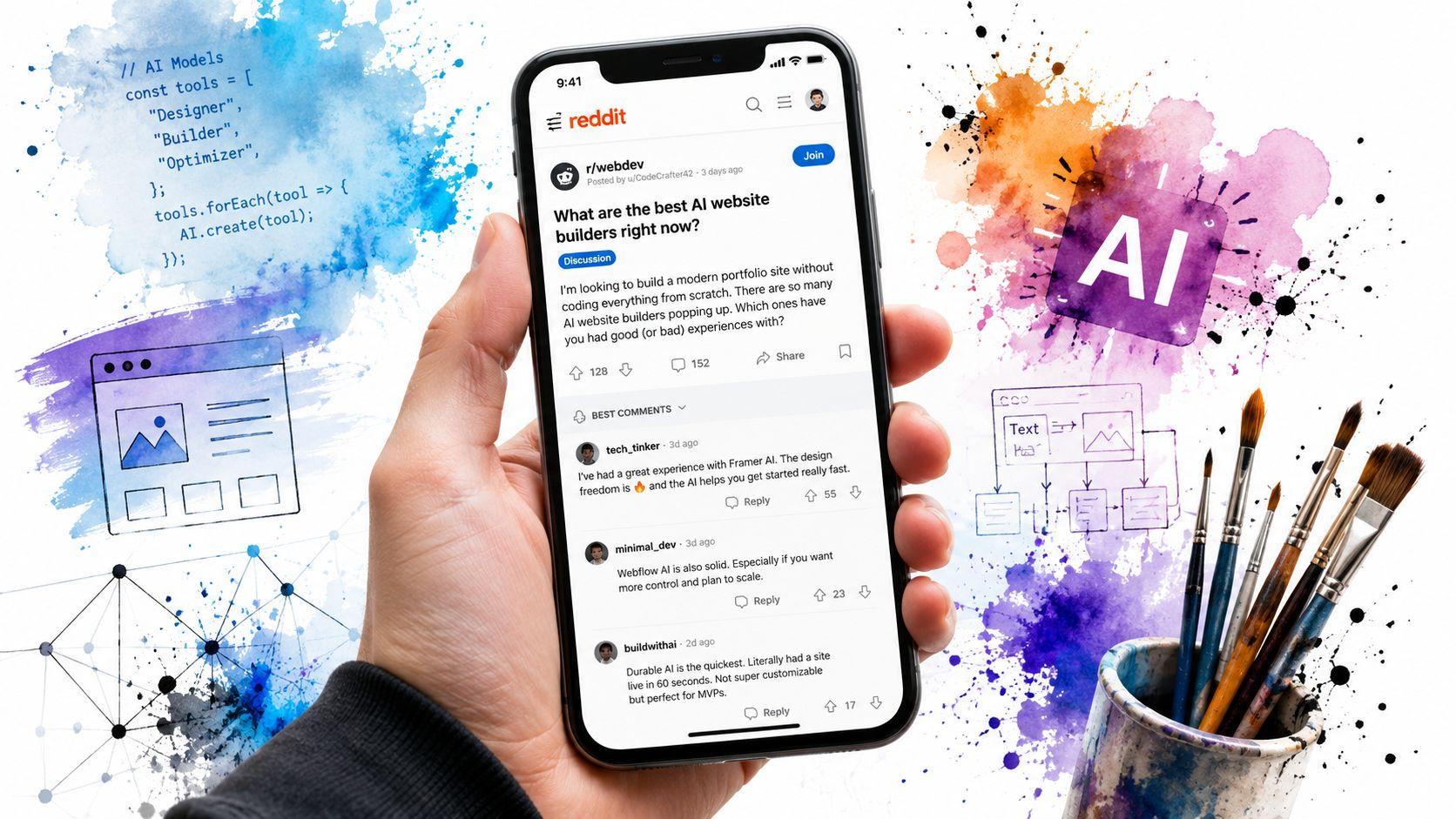
You're probably doing what most founders and small business owners do now. You search for an AI website tool, open a few polished landing pages, then head straight to Reddit to see what people actually say when no sales copy is involved.
That instinct is smart. Reddit is where people complain about broken workflows, post screenshots of weird outputs, argue about pricing, and admit when a tool only got them halfway. It's also where good advice gets mixed with outdated takes, affiliate-style hype, and comments from people building a portfolio site who think their use case matches a clinic, agency, or local service business.
The useful move isn't to avoid Reddit. It's to read it like an operator. You need to know which comments reflect real-world use, which ones are just reactions to a demo, and which trade-offs matter for your kind of business.
Why Everyone Is Searching for AI Website Builders on Reddit
Reddit feels more trustworthy than vendor websites for one simple reason. People there usually talk in specifics. They'll say the prompt worked, the design looked generic, the editor felt limiting, or the form setup broke at launch. That's much closer to the truth than “build your dream site in minutes.”

There's another reason Reddit now matters more than it used to. In 2025, Reddit was named the most cited domain in AI-generated answers across all models, according to Press Gazette's reporting on AI citation data. That matters because when someone asks an AI assistant about website tools, Reddit discussions are increasingly part of the upstream material shaping what gets surfaced first.
Why this changes how you should research
If you're searching for advice on an AI website builder on Reddit, you're not just browsing opinions. You're looking at a platform that now influences discovery itself. Reddit threads can affect which tools people hear about, which ones seem credible, and which trade-offs become “common knowledge.”
That doesn't mean Reddit is right. It means Reddit is influential.
Practical rule: Treat Reddit as a discovery engine, not a verdict engine.
A good thread can tell you what users are excited about. It can also mislead you if the top comments are old, written by hobbyists, or focused on features that don't matter to your business.
What to trust and what to question
When I read these threads, I trust comments that include context. A local service provider saying they needed booking, mobile-friendly pages, and simple editing is useful. A vague “this tool sucks” isn't.
Look for signals like these:
- Use-case clarity: Does the commenter say what kind of site they built?
- Workflow detail: Do they explain what worked after generation, not just the first impression?
- Business relevance: Are they talking about leads, appointments, contact forms, and search visibility?
- Recency: AI products change fast, so old comments age badly.
If you're trying to understand where search, discovery, and user behavior are heading next, broader resources on the top marketing trends of 2026 can help frame why community platforms and AI-assisted discovery now overlap so much.
Decoding the Hype What Redditors Praise About AI Builders
Most positive Reddit comments about AI website tools cluster around three things. Speed, simplicity, and low financial commitment. That's the primary appeal. Not design purity. Not deep customization. Speed.
A 2025 roundup of Reddit-referenced AI website tools described a category shaped by affordability and fast launch times, with options ranging from free tiers to $17 per month, and it highlighted that Durable claimed 6 million+ sites built. The same roundup also noted pricing examples like Framer at $5 per month and Squarespace Blueprint at $16 per month in that comparison set, while Reddit users favored tools that could turn a natural-language brief into a live site quickly, as covered in this analysis of Reddit discussions around AI website builders.
What people actually like
The magic moment is simple. You type a rough business description and get a site draft that looks like something you can work with.
For a non-designer, that feels like hiring an automated interior designer for your storefront. You don't start with a blank room. You start with furniture in place, lighting installed, and the walls painted. It may not be your final taste, but now you can react to something concrete.
Here's what that praise usually means in plain language:
- Fast first draft: The tool removes the blank-page problem.
- Lower risk: Free or low-cost entry makes experimentation easier.
- Less technical friction: You don't need to set up every page manually before seeing a usable result.
- Momentum: Small businesses can get something live before overthinking branding details.
Why this lands with small businesses
For many owners, “good enough to launch” beats “perfect but still unfinished.”
That's especially true if your real need is basic online presence. A homepage, a services page, contact details, maybe a booking link. In Reddit threads, that's why people keep praising builders that can take a short prompt and return a multi-page site instead of a pretty but empty shell.
The positive comments usually come from people who value progress over pixel-level control.
That's an important filter. If you want a quick site for consulting, local services, freelance work, or a small side business, Reddit praise often maps to your goals. If you want a custom funnel, advanced interactions, or a tightly controlled brand experience, the same praise can mislead you.
If you want a broader comparison set beyond scattered threads, Solo also has its own roundup of AI website builder options that's useful for checking which tools fit different starting points.
The Reality Check Common Complaints and Hidden Flaws
The complaints on Reddit are often more valuable than the praise because they reveal the hidden labor. AI can generate a site draft fast. It can't magically understand your offer, your audience, or your conversion priorities unless you tell it clearly.

That's why so many users describe the same frustration in different words. The site looks clean, but generic. The sections are there, but they say very little. The service page exists, but it doesn't sound like the business. This happens because the AI is optimizing for templated structure and fast assembly, not deep strategy.
Generic output usually starts with a generic prompt
Reddit discussions repeatedly point to the same trade-off. AI website builders are better at producing a first draft than a business-ready final draft. When users give vague instructions, they tend to get vague websites.
If your prompt is “build a website for my marketing business,” don't expect much. The tool will likely default to common patterns. Hero section, broad headline, stock phrasing, and standard service blocks.
Better inputs usually include:
- Business goal: Do you want calls, bookings, quote requests, or walk-ins?
- Page hierarchy: What pages matter most?
- Brand voice: Formal, friendly, premium, direct?
- Conversion action: What should the visitor do next?
A weak prompt produces a polished placeholder.
The hidden work starts after the site appears
This is the part many Reddit threads discover too late. Launching a generated site isn't the same as finishing one.
AI tools don't remove downstream work like SEO metadata tuning, performance checks, mobile layout review, analytics validation, and making sure forms send data where they should. Generated websites often rely on reusable components and boilerplate content, so they still need a human audit before you drive traffic to them.
That's where many founders get tripped up. They think the AI built the website, so the website must be ready.
It usually isn't.
To understand why synthetic testing and real user behavior often diverge, this piece on comparing synthetic and human users is worth reading. It's a helpful reminder that a system can look fine in generation or internal testing but still fail when real people try to use it.
A practical outside perspective on where AI website tools fall short is in this video review:
Three complaints I'd take seriously
Not every Reddit complaint matters equally. These do.
- Customization walls: Users hit limits when they want to change structure, not just text and images.
- SEO gaps: The site exists, but important search basics still need attention.
- False sense of completion: Owners publish too early because the draft looks finished.
The right takeaway isn't “AI builders are bad.” It's that they're scaffolding tools. They get the frame up fast. You still have to inspect the building before inviting people in.
Your Essential AI Website Builder Feature Checklist
When Reddit threads get noisy, a checklist cuts through the nonsense. Don't choose a tool because people say it's “cool” or “surprisingly good.” Choose it because it covers the parts of a business website that matter after launch.
The key mindset is this: generated output is only the starting point. You still need enough control to tune search visibility, review performance, confirm mobile usability, and track real business actions.
What every small business site needs
Here's the simple version. Your website needs to do four jobs well. Be found, build trust, capture intent, and give you feedback on what visitors do.
Decision shortcut: If a tool helps you publish fast but blocks you from basic business functions, it's the wrong tool for a real company site.
| Feature | Why It's Non-Negotiable (In Simple Terms) | Does Solo Offer It? |
|---|---|---|
| Custom domain | Your site needs a professional web address that people can remember and trust | Yes |
| SEO controls | This helps search engines understand your pages so customers can find you | Yes |
| Contact forms | Visitors need an easy way to ask questions or request work | Yes |
| Booking integration | Service businesses need a direct path from interest to appointment | Yes |
| Mobile responsiveness | Your site must work cleanly on phones, not just desktops | Yes |
| Analytics integration | You need to know which pages people visit and whether forms or bookings happen | Yes |
| Review import or social proof support | Credibility matters, especially if visitors don't know you yet | Yes |
| Collaboration options | If a teammate, marketer, or assistant helps update the site, shared access matters | Yes |
How to read this checklist like a buyer
Some features sound technical, but the business meaning is simple.
- Custom domain: This is your storefront sign. Without it, your business looks temporary.
- SEO controls: This is how you label shelves in a store so people can find what they need.
- Forms and booking: These are your front desk. If they're clunky, you lose leads.
- Analytics: This is your foot traffic counter. Without it, you're guessing.
Many business owners skip the boring checks because the AI-generated homepage looks polished. That's backwards. The homepage is the easy part. A key question is whether the tool supports the site after the draft is generated.
If you want a practical walkthrough of how to think about that process, Solo's guide on using AI to build a website is a useful reference for translating the idea into an actual build-and-review workflow.
A quick test before you commit
Before you choose any AI website tool, ask:
- Can I edit core page content without fighting the system?
- Can I connect the site to my real business workflow?
- Can I improve search and tracking after launch?
- Can I outgrow this tool gracefully, or will I hit a wall fast?
If the answer to two or more is unclear, keep looking.
A Smart Workflow for Small Businesses and Freelancers
The best way to use an AI website tool is not “generate and publish.” It's generate, refine, validate, then publish.
That approach matches the actual limits of the technology. Independent reviews have found that AI website tools are strong for getting a basic web presence live quickly, but they don't fully replace a developer or designer for complex sites, advanced functionality, or conversion-focused work, as discussed in this review of when AI website builders help and where they fall short.
Step one is speed on purpose
Use AI to get past the empty canvas.
Start with a prompt that includes your business type, customer type, offer, tone, and desired action. Ask for the pages you need, not a generic website. If you're a photographer, consultant, cleaner, therapist, or local contractor, the site structure should reflect that.
Good first-draft inputs usually include:
- What you sell: Services, packages, or appointment types
- Who it's for: Local families, startups, patients, homeowners, couples
- What matters most: Calls, leads, bookings, trust, speed
- What makes you different: Specialty, process, style, availability
This gets you a usable base. It does not finish the job.
Step two is human refinement
Once the draft exists, shift from generation mode to editing mode.
Replace generic copy first. AI often writes broad claims that sound fine but say nothing. Tighten headlines. Make service descriptions specific. Remove filler phrases. Add details a real buyer would care about, such as service area, timeline, approach, or specialties.
Then swap visuals. Stock imagery is one of the fastest ways to make an AI site feel fake. Real photos, even simple ones, usually outperform glossy placeholders for trust.
Most weak AI websites don't fail because of layout. They fail because the content feels anonymous.
Step three is business validation
Before launch, test the site like a customer would.
Click every button. Submit every form. Open it on your phone. Read it as if you've never heard of your business. If the value proposition isn't obvious in a few seconds, revise it.
Use this pre-launch check:
- Message clarity: Can a new visitor tell what you do right away?
- Trust signals: Are reviews, credentials, or proof points visible?
- Contact path: Is there a clear next step on every important page?
- Mobile experience: Do text, buttons, and forms work cleanly on a phone?
- Tracking basics: Are analytics and important actions set up correctly?
When to stop doing it yourself
AI alone is often enough for a straightforward brochure-style website. It's usually not enough when revenue depends on more complex behavior.
Bring in a human when:
- You need custom functionality: Portals, advanced forms, memberships, special workflows
- You need stronger conversion performance: Landing pages, testing, deeper funnel strategy
- You need a distinct brand system: Unique layouts, interaction patterns, or a design language that can't be templated easily
That's the boundary many Reddit threads blur. The question isn't whether AI can make a website. It can. The question is whether that website can carry the business task you need it to handle.
How Solo AI Website Creator Fits into Your Plan
If your goal is to follow the workflow above, the useful question isn't “Which tool has the flashiest demo?” It's “Which tool gives me a fast draft and still covers the business basics I need after generation?”

That's where product fit matters more than Reddit hype. Some tools are better for visual experimentation. Some are stronger for design control. Some are better aligned with service businesses that need a site to capture leads, support booking, and get found in search.
Where Solo fits best
Solo AI Website Creator fits the practical end of the market. It's designed to help individuals and businesses generate a site quickly, connect a custom domain, support booking, capture leads through contact forms, and connect analytics. That makes it relevant if your main goal is to launch a real business presence without stitching together too many extra tools. If you want the product overview directly, Solo's introduction page for Meet Solo AI Website Creator covers what it includes.
The strongest use case is simple. You need a credible site online fast, but you still want enough business functionality to refine it after the draft is created.
How to compare it with Reddit favorites
When Reddit users praise AI site tools, they usually praise speed and ease. When they criticize them, they usually hit limitations after the first draft. So compare tools on both phases.
Ask:
- Generation phase: Does it get you to a usable first draft quickly?
- Editing phase: Can you shape the message and structure?
- Operating phase: Can the site support SEO, forms, bookings, and analytics?
That's a better framework than copying whatever tool name appears most in a thread.
For founders who use AI across the rest of their workflow too, broader resource lists like Klap's AI tools for creators list can help place website creation in the larger stack of content, distribution, and production tools many small teams now use.
The main point is simple. Don't pick a tool because Reddit made it sound exciting. Pick the one that supports the kind of website your business needs to run.
Conclusion From Reddit Threads to a Real Website
Searching for an AI website builder on Reddit makes sense because that's where people say what polished product pages leave out. You'll find honest reactions about speed, weak prompts, generic outputs, editing frustrations, and the work that still needs to happen after generation.
The trick is knowing how to read those threads. Good Reddit advice is specific, recent, and tied to a real business use case. Bad Reddit advice is broad, context-free, and obsessed with novelty over results.
The practical path is straightforward. Use AI to get the first draft fast. Then do the work that turns a draft into a business asset. Tighten the copy, replace weak visuals, verify forms, review mobile layout, and make sure tracking and search basics are in place.
That's the true answer hiding underneath most Reddit discussions. AI is excellent at removing startup friction. It's not a substitute for judgment.
If you want to move from research to action, try Solo AI Website Creator as a fast first-draft option, then apply the review process above before you publish. That gives you the speed AI is good at, without pretending the first output is the finished website.