
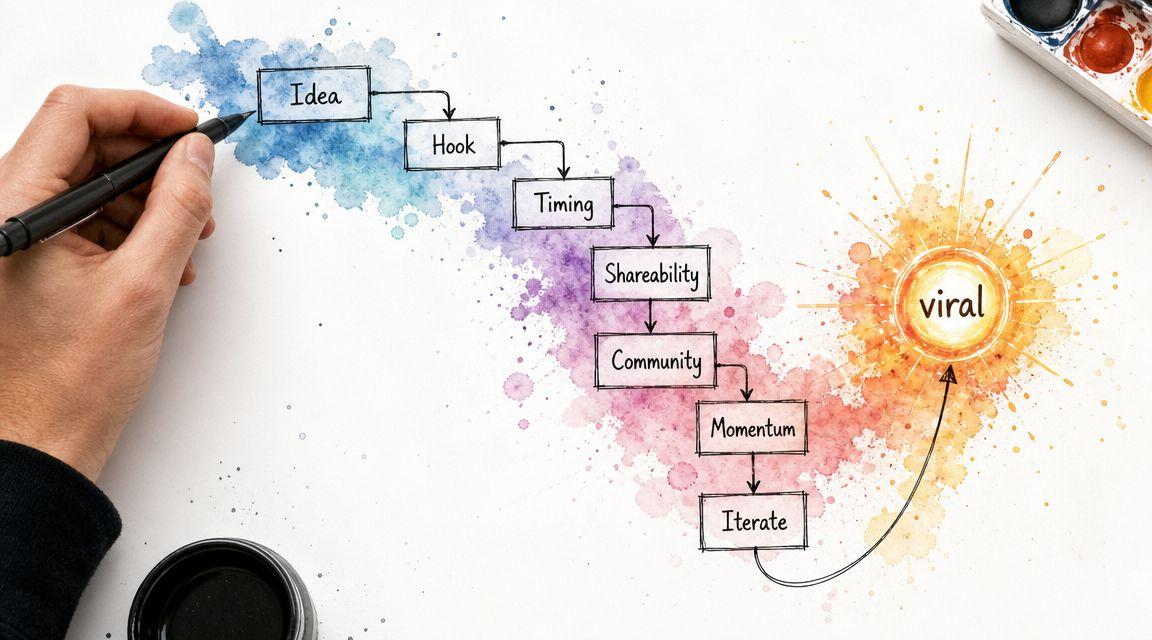
Most advice about how to go viral is wrong because it treats virality like the goal.
It isn't. For a business, virality is only useful if it creates something you still own after the spike passes: email subscribers, booked calls, repeat visitors, branded search, backlinks, customer trust, or content that keeps getting discovered. Views alone don't pay for anything.
The better question isn't "how do I get lucky?" It's "how do I create content that spreads fast enough to earn attention, then route that attention into assets my business controls?" That's the framework that separates creators chasing applause from businesses building strategic advantage.
Going Viral Is a Process Not an Accident
Luck plays a role, but "pure luck" is a lazy explanation. The hard truth is that a lot of viral posts create a burst of attention and then disappear without changing the business underneath them. A 2024 study found that most viral events on social media do not significantly increase engagement or lead to sustained growth, and when sudden growth does happen, it tends to fade quickly, while slower organic growth lasts longer, according to this 2024 PMC study on viral social media posts.
That changes how you should think about how to go viral. A breakout post isn't the finish line. It's a distribution event. If you don't have a way to capture that attention, you're renting exposure for a few days and keeping almost none of the value.

What a business needs before the spike
Small businesses usually lose viral traffic in the same three places:
- No destination: The content gets attention, but there's nowhere useful to send people.
- No offer: Viewers like the post but don't know what to do next.
- No follow-up system: The business gets a brief rush, then goes silent.
A better setup is simple. Put a clear landing page behind your content. Make the next action obvious. Use one CTA per post. If you're a freelancer, that might be a booking page. If you're a local business, it might be a service page with reviews and contact details. If you're a nonprofit, it might be a donation or volunteer page tied to the topic of the post.
Practical rule: Build the capture system before you chase the spike.
Virality works best when it's attached to a funnel
The businesses that benefit most from viral content don't rely on one masterpiece. They treat content like a repeatable acquisition channel. Some posts are built for reach. Others are built for trust. Others convert the new audience.
That also means you shouldn't confuse "popular" with "useful." A funny clip can spread widely and still bring weak business results. A niche clip can travel less and bring better leads because it attracts the right viewer. If you want a useful companion read on the creative side, this guide on how to make videos go viral is worth reviewing alongside the business systems behind distribution.
Use virality as an input. Not as the company strategy.
Define Your Viral Hook and Audience
Before you write a script or edit a reel, decide why someone would share it. Not why they'd watch it. Not why they'd agree with it. Why they'd send it to another person.
That's the difference between content people consume and content people distribute.
Think in terms of sharers, not followers
A target audience isn't just "women in real estate" or "small business owners in Chicago." That's too broad to help you make content. What matters is the sharing motive behind the audience.
Most shareable content gives the viewer one of a few social benefits:
- Identity: Sharing says something about who they are.
- Utility: Sharing helps a friend solve a problem.
- Emotion: Sharing lets them express surprise, frustration, relief, humor, or pride.
- Status: Sharing makes them look early, informed, sharp, or useful.
A tax accountant, for example, shouldn't just post "tax tips." That's generic. A stronger hook is content a business owner wants to pass to a partner or friend because it protects them from a mistake, makes them look informed, or gives them language for a problem they've struggled to explain.
Build a shareability hypothesis
Before publishing, write a one-line hypothesis for the piece:
- Who is most likely to share this?
- Who will they share it with?
- What emotion or identity signal triggers the share?
- What belief, tension, or question does the content resolve?
Examples:
- A fitness coach might target busy parents with "the workout myth that wastes your only free half hour."
- A web designer might target founders with "the homepage mistake that makes your business look expensive and confusing."
- A nonprofit might target volunteers with a story that validates why small actions still matter.
Each example gives the viewer a reason to pass it on, not just nod along.
If your content is only "good information," people may save it. If it also helps them communicate something about themselves, they're more likely to share it.
Use a hook that matches business reality
Not every strong hook should be used. Some get attention but attract the wrong audience. A controversial opinion might travel fast and still fill your comments with people who will never buy from you.
Use this filter before you publish:
| Question | Keep it if the answer is yes |
|---|---|
| Does this hook attract the people I actually want? | Yes |
| Does it connect naturally to my service or offer? | Yes |
| Can I defend it in the comments without sounding foolish? | Yes |
| Would I still be comfortable if this reached far beyond my existing audience? | Yes |
If the answer is no on most of those, the hook may be viral bait, but it isn't good marketing.
Find the tension your audience already feels
The best hooks rarely invent a new desire. They name an existing tension more clearly than everyone else. That's why simple formats often outperform polished brand content. They feel immediate. They feel true. They sound like something a real customer has said out loud.
Look in places where your audience already reveals friction:
- Sales calls: What do prospects keep asking?
- Customer emails: What do they misunderstand before buying?
- Comments and DMs: What gets repeated?
- Reviews: What language do happy customers use when describing the result?
That language is raw material. Use it in the opening line, on-screen text, title, and caption. If the audience recognizes the problem instantly, the content gets a better chance to travel.
Crafting Contagious Content Formats
Format matters because platforms don't evaluate content like a human editor. They watch behavior. People stop or keep scrolling. They replay or drop off. They share or ignore. That's why contagious content usually feels obvious very early.

A useful starting point is short-form video. According to this guide to making viral video content, high-performing short-form videos often use a 2-phase structure: a hook in the first 1 to 3 seconds, then repeated value peaks to hold attention. The same guide notes that TikTok videos with the highest share rates are typically 21 to 34 seconds, while Instagram Reels often perform best around 15 to 30 seconds.
Use the two-phase structure
A lot of businesses waste the opening by introducing themselves.
Don't start with your logo, your title, or a slow setup. Start with the tension, result, contradiction, or visual change. Then earn the rest of the watch with a sequence of small payoffs.
A simple structure looks like this:
- Hook immediately: State the mistake, claim, surprise, or outcome.
- Deliver the first payoff fast: Show the proof, example, or explanation.
- Interrupt the pattern: Change angle, text, pace, framing, or scene.
- Add another payoff: Give a second useful or emotional moment.
- Close with direction: Tell people what to do next, comment on, or click.
Here are hooks that usually beat generic intros:
- Contrarian: "Most local businesses are posting the wrong kind of reel."
- Specific problem: "If people ask for your price and then disappear, this is usually why."
- Demonstration: Start with the before and after.
- Audience callout: "Freelancers who are fully booked still make this mistake."
Why some posts suddenly explode
Virality often looks random from the outside because people only notice the spike. Underneath it, distribution tends to concentrate around a small number of high-impact sharing moments. Research from Florida Tech explains that viral sharing can be modeled as self-exciting events, where each repost can increase the chance of more reposts for a period of time. The same research describes viral diffusion as being driven largely by a small number of super-spread events, rather than steady linear growth, in this Florida Tech explanation of viral probability and repost behavior.
That matters because your job isn't to appeal to everyone equally. It's to make something a small number of contagious sharers want to pass along quickly.
The early life of a post matters more than most businesses think. If the first wave of viewers shares it, the curve can change fast.
Formats that spread well for small businesses
Not every business needs dances, pranks, or creator-style comedy. These formats are more practical:
- Reaction plus explanation: Respond to a common misconception in your industry.
- Mistake teardown: Show one problem, then fix it quickly.
- Before-and-after proof: Great for service businesses, design, fitness, cleaning, and home services.
- Mini myth-busting: Short, clear, and easy to share when someone believes the opposite.
- Template content: Scripts, checklists, or phrases people can reuse.
And yes, memes can work for businesses. But the meme should connect to a real buying tension. A funny post that has no bridge to your offer usually builds weak attention.
A good reference for pacing and format decisions is below. Watch how quickly the value appears, then notice how often the video introduces a new stimulus before attention drifts.
What usually fails
Three patterns kill shareability:
- Slow openings: The viewer can't tell why they should care.
- Overproduction: The edit looks polished but hides the payoff too long.
- No social reason to share: The content is competent, but it doesn't help the viewer express anything to someone else.
The fix isn't to make every post louder. It's to make the value easier to detect in motion.
Optimize Your Content for Each Platform
The fastest way to suppress good content is to post the same asset everywhere without adaptation. Platforms may all host video, but they don't reward the same behaviors in the same way.
Cross-platform seeding can multiply reach, but the execution has to fit the environment. One industry analysis notes that viral thresholds vary by platform. On TikTok, virality for smaller creators is often described as 1 to 5 million views in 24 to 48 hours, while YouTube can be closer to 1+ million views within a week for mid-sized channels. The same analysis also recommends minimal hashtag use on Facebook while leaning much harder into trends and discoverability mechanics on other platforms, as explained in this cross-platform guide to going viral on YouTube and social media.
Platform-Specific Virality Cheatsheet
| Platform | Ideal Length | Key Signal | Hashtag Strategy |
|---|---|---|---|
| TikTok | 21 to 34 seconds | Fast engagement, shares, trend alignment | Use trending sounds and broader hashtag support |
| Instagram Reels | 15 to 30 seconds | Watch time, replays, audio relevance | Use relevant hashtags selectively |
| YouTube Shorts | 30 to 50 seconds | Viewer satisfaction, retention, continued viewing | Focus more on title and packaging than hashtag volume |
| Native short video for the feed | Immediate engagement and feed fit | Keep hashtags minimal, around 1 to 2 |
What to change on each platform
TikTok favors participation. Content usually performs better when it feels native to the app's rhythm, language, and trend behavior. That doesn't mean copying every trend. It means understanding the platform's editing tempo and social cues.
Instagram Reels often rewards content that looks clean, feels emotionally legible, and uses audio intentionally. Reels can work well for service businesses when the visual transformation is obvious, such as styling, renovation, treatment, cleaning, or behind-the-scenes expertise.
YouTube Shorts is stronger when the topic has enduring curiosity, not just momentary trend appeal. The title matters more here. So does the likelihood that the viewer will continue watching related content after your short.
Facebook still deserves attention for certain small businesses, especially local and relationship-driven ones. Native posting, square formatting for feed space, and lighter hashtag use often make more sense than importing a TikTok strategy unchanged.
Working rule: Adapt the packaging, not just the file.
Metadata is part of distribution
Many teams focus on the clip and ignore the wrapper. That's a mistake. Titles, thumbnails, captions, on-screen text, keywords, and comment replies all affect whether the post gets a fair chance.
A practical prep checklist:
- Title for curiosity: Make the topic clear without sounding vague or spammy.
- Thumbnail for contrast: On YouTube, bold visual contrast usually beats cluttered design.
- On-screen text for silent viewing: Many people decide whether to keep watching before turning sound on.
- Native formatting: Export for the platform instead of recycling one version everywhere.
- Comment response: Early replies can strengthen engagement signals and add clarity.
If you're unsure where your current social setup is weak, run a simple review against this small business social media audit guide. It helps surface issues that block distribution before the content itself gets blamed.
Amplify Your Reach with Seeding and Ads
Good content doesn't automatically get the initial push it needs. Early distribution still has to be earned or engineered. That's why seeding matters.
The reason is structural, not just tactical. Viral diffusion often depends on a small number of high-impact repost moments. Mathematical models described by Florida Tech show that reposts are self-exciting, which means each share can increase the probability of later shares for a period of time. In plain English, the first wave can change the trajectory of the whole post.
Seed where the audience already gathers
Start with communities that already care about the topic. That might be a niche Facebook Group, a subreddit, an industry Slack, a LinkedIn comment thread, a customer email list, or a partner network. The goal isn't to dump links everywhere. It's to place the content where the right people are already primed to react.
The best seeding usually has one of these qualities:
- Contextual: The post directly answers a question the community is already discussing.
- Native: You rewrite the framing to fit the community instead of pasting a generic promo line.
- Reciprocal: You've participated before asking for attention.
If you seed without context, people smell promotion instantly. If you seed with relevance, the post feels useful enough to spread on its own.
Use small paid pushes like testing fuel
Ads don't make weak content strong. They can, however, help strong content clear the first distribution window. For small businesses, the best use of paid amplification is often validation. Put limited spend behind a few promising variations, then watch which one earns the strongest engagement quality.
Use paid support when:
- You have multiple hooks to test
- You need feedback quickly
- The audience is narrow and hard to reach organically
- You already know the post connects to a real offer
Skip paid amplification when the CTA is unclear or the landing experience isn't ready. Paid reach poured into a weak destination just wastes money faster.
For social promotion workflows, creative testing, and publishing systems, this roundup of AI social media tools for small businesses is a useful operational reference.
Don't fake momentum in the wrong places
Some marketers try to manufacture social proof with low-quality engagement. That can create the appearance of traction, but it often doesn't create the reactions that matter. If you're researching how visibility mechanics work on community platforms, guides such as this one on buy quora upvotes are best treated as a window into promotion tactics, not a substitute for relevance, timing, or a strong idea.
Seeding works when it helps the right people discover a post they already want to share. It fails when it tries to impersonate real interest.
Turn Viral Attention into Business Value
Most "how to go viral" advice disappoints. It stops at reach. Businesses need the next step.
Many people now discover content through search behavior, not just feed scrolling. YouTube has also emphasized that search and recommendations are driven by viewer satisfaction signals, and for small businesses the stronger long-term play is often creating discoverable content that answers real customer questions. A trustworthy website with clear service pages converts that intent-driven traffic better, as discussed in this YouTube explanation of search, recommendations, and viewer satisfaction.

Route attention into assets you own
When a post breaks out, send people somewhere stable and useful. For most small businesses, that means a website page built around one clear intent.
That destination should do four jobs:
- Match the promise of the post
- Explain the service or offer quickly
- Show trust signals such as reviews, examples, or proof
- Give one obvious next action
If the viral post is educational, the destination can be a service page or FAQ. If the post is story-driven, the destination might be a lead magnet or consultation page. If the post is tied to a local service, the page should make booking frictionless.
Build content that compounds after the spike
The best viral content doesn't only generate a temporary rush. It creates topics your business can own. A good short video can become a blog post, an FAQ entry, an email sequence, a service page update, a pinned social post, and a YouTube search asset.
That turns attention into a library.
A practical repurposing path looks like this:
- Short video: Capture the hook and the first wave of interest.
- Website article: Expand the answer for search and trust.
- FAQ page: Address the objections raised in comments.
- Lead capture page: Offer a checklist, consultation, or booking step.
- Email follow-up: Continue the conversation after the click.
If you want to measure whether visibility is concentrating around your brand versus competitors, a framework like this share of voice formula can help you think beyond views and toward market presence.
Viral reach is borrowed attention. Search traffic, email subscribers, and direct visits are retained attention.
Judge success by business movement
A viral post can be worth very little if it doesn't create qualified action. Look at the downstream signals that matter to your model: inquiries, booked calls, quote requests, email signups, time on key pages, or branded search demand.
That mindset also changes what content you prioritize next. Instead of asking which post got the most applause, ask which topic brought the most useful visitors and the clearest buying intent. Then make follow-up content around that topic. This small business content marketing strategy guide is a solid reference for building that longer arc instead of depending on one-off spikes.
If you want a simple home base ready before your next content spike, Solo AI Website Creator makes it easy to launch a professional site with service pages, contact forms, booking paths, and SEO-friendly structure without wrestling with complicated web design. That's the difference between getting attention and keeping its value.